
why is a landfill anaerobic?
A landfill is anaerobic (oxygen-free) by design and by physics. The oxygen gets locked out through
- Daily compaction of waste.
- Daily earth cover.
- Quick consumption of the remaining oxygen by aerobic bacteria.
- And finally by an engineered final cap of the cell at its end of life.
Under anaerobic wet conditions waste decomposes faster than if it were just left sitting dry. So we want the landfill to be anaerobic! The resulting methane however is a potent greenhouse gas—about 27 to 30 times more effective at trapping heat than CO2 over a 100-year period (GWP100), and 81 to 83 times GWP over a 20 year period (GWP20) highlighting its immediate danger to tipping points.
Our desire hence shall be to capture this methane by applying controlled vacuum through a Gas capture and control system (GCCS), and use the methane as a renewable energy source; Renewable Natural Gas (RNG).
how does a LF become an anaerobic reactor? how does it produce methane?
A landfill doesn’t start anaerobic; it becomes anaerobic through four distinct phases as the oxygen is used up.
- The Aerobic Phase (The “Starting” Phase): When waste is first dumped, air is trapped within the waste mass. Aerobic microorganisms degrade the readily biodegradable organic matter (such as food waste) using the available oxygen for their metabolic activity. This phase is short—it lasts only days or weeks until the oxygen is depleted.
- The Acidogenesis Phase (Transition): Once the oxygen is depleted, facultative bacteria become dominant. They break down long-chain compounds (fats, proteins, complex carbs) into compounds like volatile fatty acids and alcohols. The Result: The landfill environment becomes very acidic (low pH), and the leachate (the liquid at the bottom) becomes highly corrosive.
- The Acetogenesis Phase: Specific bacteria convert those organic acids into acetic acid (essentially vinegar), hydrogen, and carbon dioxide. During this stage, intermediate compounds accumulate, contributing to strong and characteristic acidic odors within the landfill environment.
- The Methanogenesis Phase (Full Anaerobic Reactor): This is when specialized microorganisms called methanogens consume the acetic acid and hydrogen to produce Methane (CH4). By now controlled landfill has become a stable, pH neutral (7.0), oxygen-free reactor producing biogas, usually 50% methane and 50% CO2.
what is LFG / biogas / sewage gas?
They are all products of Anaerobic Digestion—the process of bacteria eating organic matter in the absence of oxygen.
- Landfill gas is the product of MSW degradable matter is a mix of food scraps, paper, textiles and wood, some degrades in a matter of months, some in a matter of years (k-factor, see below). LFG is 50% methane and 50% CO2, unless the applied vacuum is too strong and drags air (N2 and O2 inside).
- Biogas is the product of an AD reactor, a machine where we control feed/diet (e.g. cow manure and slurry), temperature, and control parameters such as pH or ammonia by adding trace elements, enzymes, and the like. Depending on feed methane is 50% to 75%.
- Sewage gas is biogas from a wastewater sludge treatment process, basically a byproduct of cleaning toilet water. Methane is usually higher than 60%.
While H2S is always present (more so in sewage gas), there tends to be more Volatile Organic Compounds (VOC) and siloxane in LFG.
how can LFG be measured?
Once there is a LFG capture and control system in place we can measure the gas flow in m3/h and the quality of the gas in percentage of methane. generizon supplies equipment to accomplish this.
Before a full system is in place two approaches are at our disposal?
- Bottom up approaches include above mathematical modelling of emissions (foremost the IPCC FOD model, see below). One can also take gas measurements under a small dome (measure the increase in methane concentration) or pressure measurements under ground and calculate overall methane emissions.
- Top down approaches include direct optical spectral observation, by satellite, aircraft or drone, or simply walking the landfill with a gas measuring device in a raster, the socalled Surface Emission Monitoring (SEM).
IPCC FOD modeling – core expertise @generizon
generizon has conducted extensive research to identify the most credible and scientifically robust model for estimating landfill gas (LFG) emissions.
The first model assessed by generizon was logically the EPA’s LandGEM model (landfill gas estimation model). LandGEM, when it came out in 1991 was the first automated way to use the First-Order Decay (FOD) equation; it has since been widely used in studies and technical literature. It became the industry standard and is pretty much still the standard in the US. While practical and easy to apply, LandGEM relies on a limited set of parameters: total waste quantity (M), start and end years of landfilling, the methane generation rate (k), and the methane generation potential (L₀). The model provides only two default climate categories (arid and conventional), which limits its ability to reflect site-specific conditions.
Seeking a more accurate (and sophisticated) approach, generizon tested several adoptions of the IPCC model (which shifted to FOD in 2006, the “Waste Model” spreadsheet).
While the FOD approach (already implemented 1991 in LandGEM) reflects the biological reality that waste decomposes progressively, rapidly in the early years and then gradually declining, the IPCC model after 2006 is widely considered the more scientifically sophisticated tool for global carbon accounting.
The main advantages of the IPCC model lie in its granularity (allowing for different waste categories, defining degradability by waste type) and its ability to adapt to international diversity (hot vs. cold, humid vs. dry climate, dumpsite vs. controlled landfill, etc.).
The IPCC model is designed to talk to other models, it integrates with a country’s carbon footprint calculations.
The IPCC model’s key factors are:
- kj (methane generation rates of waste types j), adjusted according to waste composition and climate category.
- DOCj (Degradable Organic Carbon by waste type j); DOCj is what goes into the landfill.
- DOCf (fraction of degradable organic carbon that decomposes); DOCf is the portion that actually turns into gas.
- Methane Correction Factor (MCF) and Oxidation Factor (OX), which depend on landfill depth and management type (sanitary landfill, controlled dumpsite, or unmanaged dumpsite).
In generizon the team has fully mastered the methodology and has programmed the IPCC equations into its own spreadsheet calculation tools, enabling advanced scenario analysis and parameter adjustments to better reflect real operational and climatic conditions. This approach ensures emissions projections that are technically sound, transparent, and aligned with international standards.
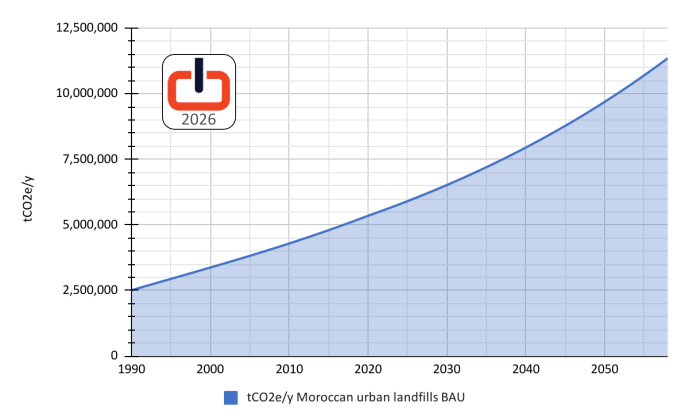
The application of IPCC modeling to major landfills in Morocco has historically defined our expectations for methane emissions. These projections have now reached a significant milestone of validation: where available they closely align with independent, high-resolution data captured by satellite platforms like Carbon Mapper or GHGSat. This synergy between bottom-up mathematical modeling and top-down spectral observation reinforces the accuracy of the methodology, confirming that our calculated inventories are scientifically sound and mirror the physical reality observed from space.
Armed with emission estimation results from major landfills, generizon projects emissions for the whole of urban Morocco through to 2060. Under a Business-As-Usual (BAU) scenario—where all waste continues to be landfilled—methane emissions reached in 2025 approximately 5.9 MtCO₂e per year.
critical appreciation IPCC – FOD model estimates vs. satellite data.
The IPCC First-Order Decay (FOD) model serves as a rigorous, bottom-up baseline for our emission inventories. Because this methodology is inherently conservative, generizon’s emission estimates function as a guaranteed floor rather than a ceiling; while we ensure emissions are never under-reported, the true atmospheric impact may be significantly higher. Consequently, this data provides a reliable, high-integrity benchmark for year-over-year performance tracking and mitigation planning.
Top-down approaches on the other side—such as aircraft or satellite observations—can either overestimate or underestimate methane emissions depending on several external factors. These include wind speed and direction, atmospheric dispersion conditions, and site topography. For example, methane emissions may accumulate or be pulled into low-elevation areas rather than being detected over surrounding hills, leading to spatial variability in measured concentrations. Additionally, some emissions are highly diffuse and therefore difficult to observe accurately.
For satellite-based assessments in particular, reliable conclusions require multiple measurements over time, as one or two observations are not sufficient to represent average or long-term yearly emissions. The more data, the better. Combining repeated observations improves representativeness and reduces uncertainty.
the k factor over time: generizon’s perspective on MSW decomposition.
The k factor is one of the most critical parameters in the IPCC methodology, as it represents the methane generation rate—that is, the speed at which methane is produced from each type of waste under specific climate conditions. It reflects the kinetics of organic matter degradation: methane generation is highest during the early stages after waste disposal and gradually declines over time as the degradable organic content is depleted.
In practice, this means and is especially true for food waste, that a significant portion of methane is generated before landfill cells are properly covered and before a Gas Capture and Control System (GCCS) is installed. As a result, large volumes of landfill gas (LFG) escape into the atmosphere and cannot be recovered.
To address this challenge, generizon has developed an integrated, game-changing approach that combines mitigation and valorization strategies:
- Degassing systems for already landfilled waste (old cells) to capture residual methane emissions. The implementation of active gas collection in legacy landfill cells is a non-negotiable debt owed by the waste-generating generation to mitigate the environmental damage left behind.
- Composting of green waste, producing high-quality compost for agricultural applications. Green tree trimmings and lawn cuts are by definition source separated waste, the logistics can be managed.
For newly generated waste (the future), two complementary pathways are proposed. Both divert organic waste from landfilling:
- Recovery of Source-Separated Organic Waste (SSOW), best treated in a Continuously Stirred Tank Reactor (CSTR) to ensure stable and efficient biogas production.
- Treatment of the Organic Fraction of Municipal Solid Waste (OFMSW) after mechanical sorting (typically ~10% contamination), optimally processed in a plug-flow reactor, also known as a high-solids anaerobic digestion (HSAD) system.
This integrated model maximizes methane recovery, minimizes uncontrolled emissions, and shifts waste management from passive disposal toward active resource recovery.
government-endorsed IPCC methodology for GHG emissions inventories.
The IPCC methodology is the internationally recognized standard for greenhouse gas emissions inventory calculations and is fully aligned with UNFCCC (United Nations Framework Convention on Climate Change) reporting requirements. As the reference framework used for national inventories, it ensures transparency, consistency, and scientific credibility. It is also widely accepted for the monitoring, reporting, and verification (MRV) of emissions reductions under a country’s Nationally Determined Contributions (NDC), and forms the methodological foundation of many carbon credit mechanisms, including Article 6 and voluntary carbon markets. Using the IPCC approach therefore guarantees that emissions estimates are robust, verifiable, and compatible with climate finance frameworks.