waste-to-energy – WtE.
Waste-to-Energy (WtE) is commonly perceived as the incineration or co-incineration of waste streams with energy recovery. However, from a broader and more integrated technical perspective, WtE encompasses any technology capable of converting waste into usable energy carriers, including electricity, heat, biogas, biofuels, or other renewable energy vectors.
In the Moroccan context, the thermal treatment of municipal solid waste (MSW) through direct incineration presents significant technical and economic constraints. Moroccan MSW is characterized by a high proportion of biodegradable organic matter and elevated moisture content, resulting in a relatively low Lower Heating Value (LHV).
For stable and energy-efficient incineration, a minimum LHV of approximately 6 MJ/kg, is generally required. A high water content reduces combustion efficiency; it may even require auxiliary fuels to sustain the process. In addition, in Morocco, the plastic fraction, which typically contributes to keeping overall calorific value high, is significantly reduced due to informal waste picking activities and upstream recovery through Material Recovery Facilities (MRFs).
generizon’s calculations have revealed a LHV of 6-8.3 MJ/kg, depending on the existence of an MRF and final waste characteristics to be incinerated.
For any incineration to work these fundamental structural characteristics of the Moroccan MSW stream necessitate drying as a first pre-treatment step to enhance the waste’s calorific value and ensure process stability.
Considering the organic-rich composition of Moroccan MSW, generizon positions anaerobic digestion (AD) as the more technically adapted and context-relevant WtE pathway, and as the core technology within its integrated approach.
generizon’s model is structured around a systemic and complementary framework that includes:
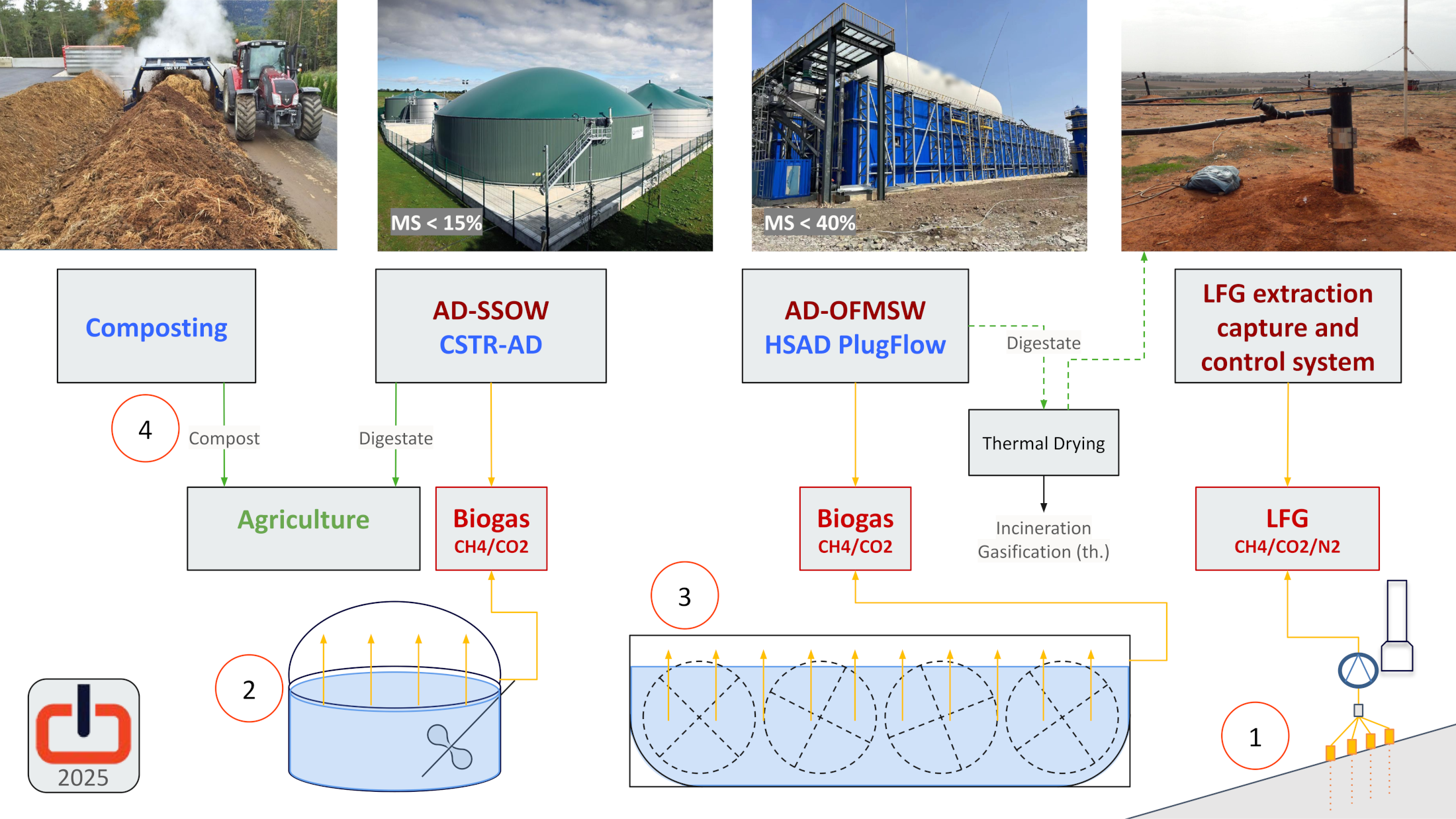
- Landfill Gas (LFG) extraction systems implemented across all the major Moroccan closed landfills and active landfill cells in Morocco, ensuring methane capture and climate mitigation. This is on the one side a debt that must be paid, to the environment and future generations, on the other side an opportunity to harvest cheap renewable gas.
- Anaerobic digestion of Source-Separated Organic Waste (SSOW) in Continuous Stirred-Tank Reactors (CSTR), enabling controlled and optimized biogas production and high value organic fertilizer for agriculture.
- Anaerobic digestion of the Organic Fraction of Municipal Solid Waste (OFMSW) post MRF/MBT in plug-flow reactors, after MRF, adapted to partly contaminated (10%) and higher solids waste streams, with post digestate drying and RDF production.
- Composting of green waste, as there is really no need to landfill tree cuts, to ensure organic and material recovery and soil amendment production.
1-3 produce biogas. 2 and 4 represent material recovery.
This integrated approach aims to maximize resource recovery while addressing Morocco’s structural waste management challenges. It enables the production of green, carbon-neutral/negative biogas that can be converted into electricity or upgraded to biomethane for (gas grid injection) and all advanced energy applications (see advanced energy).
In the case of 2, CSTR AD for SSOW the plant also generates high-quality biofertilizer (digestate from clean SSOW), in the case of 4, it produces a compost from source separated green waste). Case 3 produces in addition to a lot of biogas Refuse-Derived Fuel (RDF) from dried digestate, hence replaces fossils incinerated in cement kilns and contributes to the decarbonization of the sector. Gasification of dried digestate is another, more theoretical solution.
All, 2 to 4, significantly help in reducing leachate generation rates — one of the most persistent environmental challenges associated with landfilling in Morocco.
By combining biological treatment, energy recovery, and material valorization, generizon’s approach ensures climate performance, circularity, and long-term environmental sustainability.
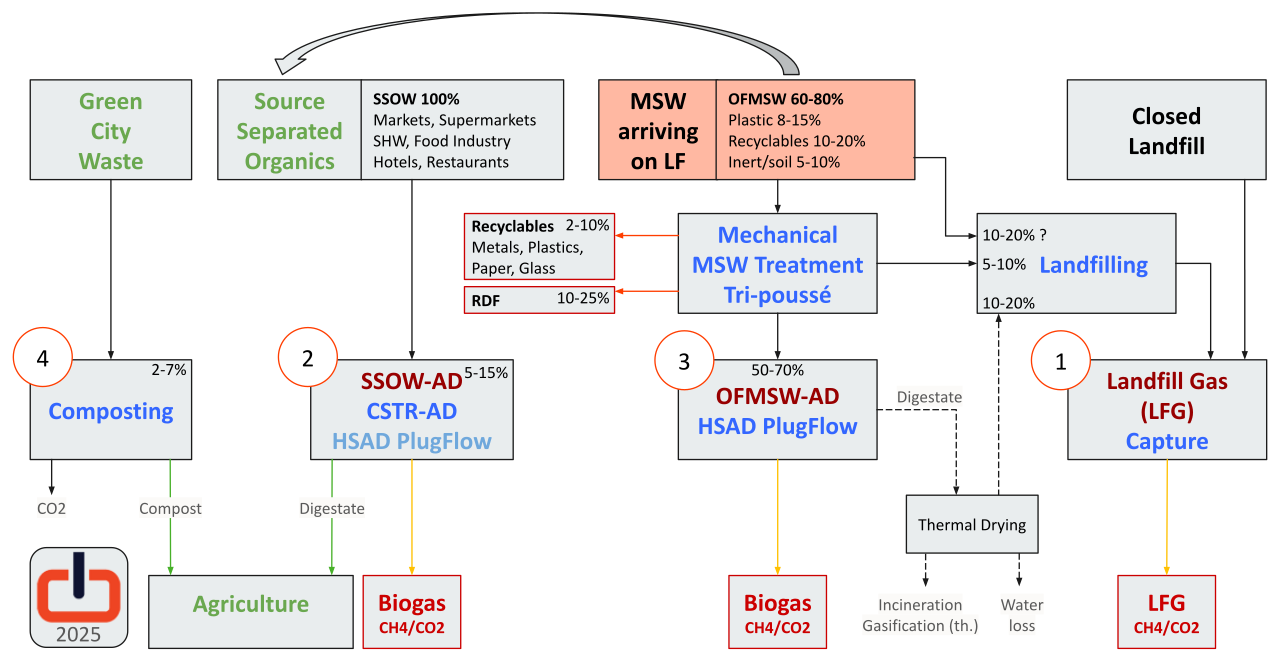
generizon’s integrated approach.
Moroccan MSW constitutes the core pillar of generizon’s technical expertise and strategic positioning. Over the years, generizon has developed an in-depth understanding of Morocco’s household waste composition, moisture content, LHV, and methane generation potential under Moroccan climatic conditions. Particular attention has been given to methane emissions arising from both landfilling and anaerobic digestion processes, as well as to biogas and LFG estimation methodologies.
generizon’s work on MSW, particularly organic waste streams has been conducted through a rigorous scientific and technical framework, applying internationally recognized methodologies such as the IPCC waste model (see IPCC/waste) for methane emission quantifications and projections. This analytical foundation has enabled a precise assessment of the sector’s climate impact and mitigation potential.
Through this reflection and sectoral analysis, generizon evaluated how to effectively mitigate and optimize methane capture from the waste sector, recognizing methane as a potent Short-Lived Climate Pollutant (SLCP) and greenhouse gas (GHG). While landfilling combined with a Gas Capture and Control System (GCCS) represents an improvement over uncontrolled disposal (the Moroccan BAU methodology of MSW treatment), it won’t ever fully eliminate atmospheric methane emissions. Based on technical assessments, generizon has come to the conclusion that practical capture efficiencies under Moroccan conditions typically will never exceed 50% and most likely remain well below said 50%.
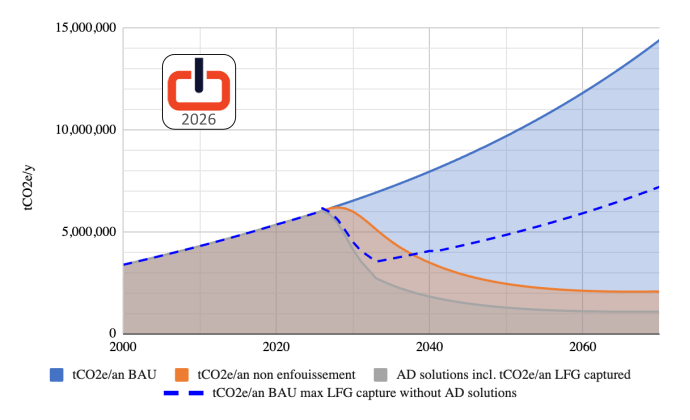
This limitation is primarily linked to the methane generation rate, the constant (k), which is higher during the very early stages of waste degradation—before landfill cells are closed (the open side of a landfill), and most important well prior to the full deployment of LFG extraction infrastructure. As a result, a significant fraction of methane is emitted before efficient collection systems become operational.
In response to these structural constraints, generizon developed an integrated and proactive approach. This model was shaped through comprehensive technical and financial prefeasibility benchmarking, aiming to move upstream in the waste management hierarchy, maximize methane recovery, and ensure both climate performance and economic viability.
generizon’s Integrated Waste Valorization Approach:
- Degassing systems for existing landfills (old existing cells): Active landfill Gas (LFG) extraction to reduce legacy methane emissions and recover energy.
- Source-Separated Organic Waste Anaerobic Digestion (SSOW-AD) in a CSTR reactor for optimized biogas production and stable operation and to produce a fertilizer for agriculture (100% circularity).
- Organic Fraction of Municipal Solid Waste (OFMSW) High-Solids Anaerobic Digestion (HSAD), in a plug-flow reactor, suitable for sorted organic material post MRF with ≈10% contamination (plastic, paper, etc.).
- Composting of green waste: Production of high-quality compost for agricultural use, supporting nutrient recycling and circular economy principles.